Three months before Russia invaded Ukraine, I wrote a piece for New_ Public with thoughts on how our grieving and memories move online. Today, this piece has a completely different meaning as many Ukrainians gave up their life to protect the freedom of my country. Below is a link to the full issue with my writing included.
To all my American readers, I put together a template letter you can send to your Congress representatives and Senators to ask for air defense systems for Ukraine. We need to protect our skies from russian missiles and aircraft.
Hi 👋 before you get to the newsletter, I have an announcement: I'm taking time off from writing to figure out what will happen next with my newsletter. The recent crisis on the Ukrainian border hit hard my personal digital hygiene and I wasn’t able to write a lot. To Ukrainian friends of this newsletter, I want to say - we’ll get through this!
Moreover, It's been almost a year since I started writing regularly - the first article was published in May, but prior to it, I wrote a few drafts that never saw the light of day. I enjoyed writing and drawing immensely, but it feels like topics have been exhausted. I can't yet tell you how this publication will evolve, but I hope you'll stick around to find out.
Thank you for your support 🙂
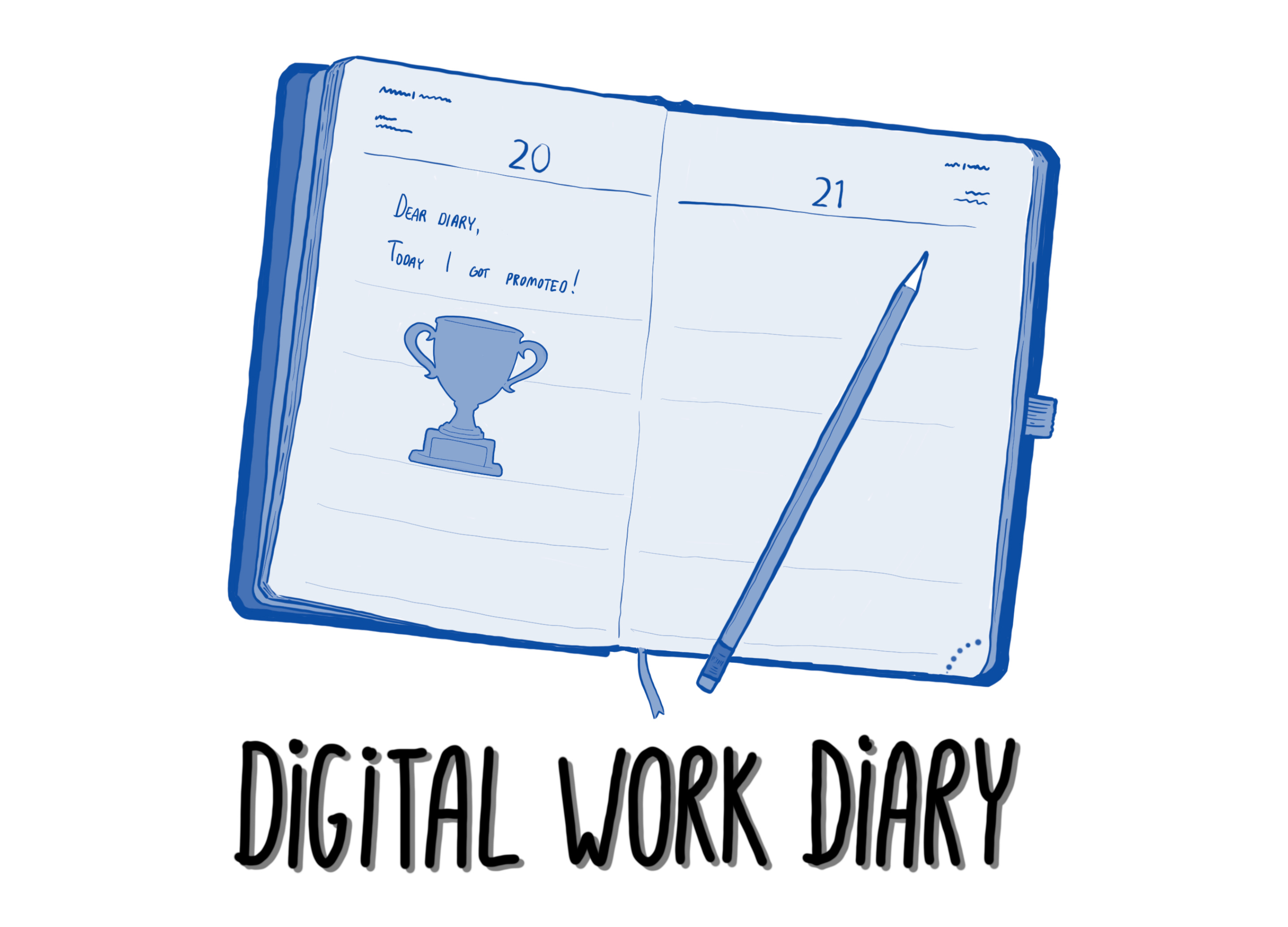
Presenting our work accomplishments is hard. Yet, articulated work accomplishments give us a stronger sense of self-worth, help craft CVs and write performance reviews.
1️⃣ Record praise at work
2️⃣ Find medium to present accomplishments
3️⃣ Use online content as a fuel for career growth
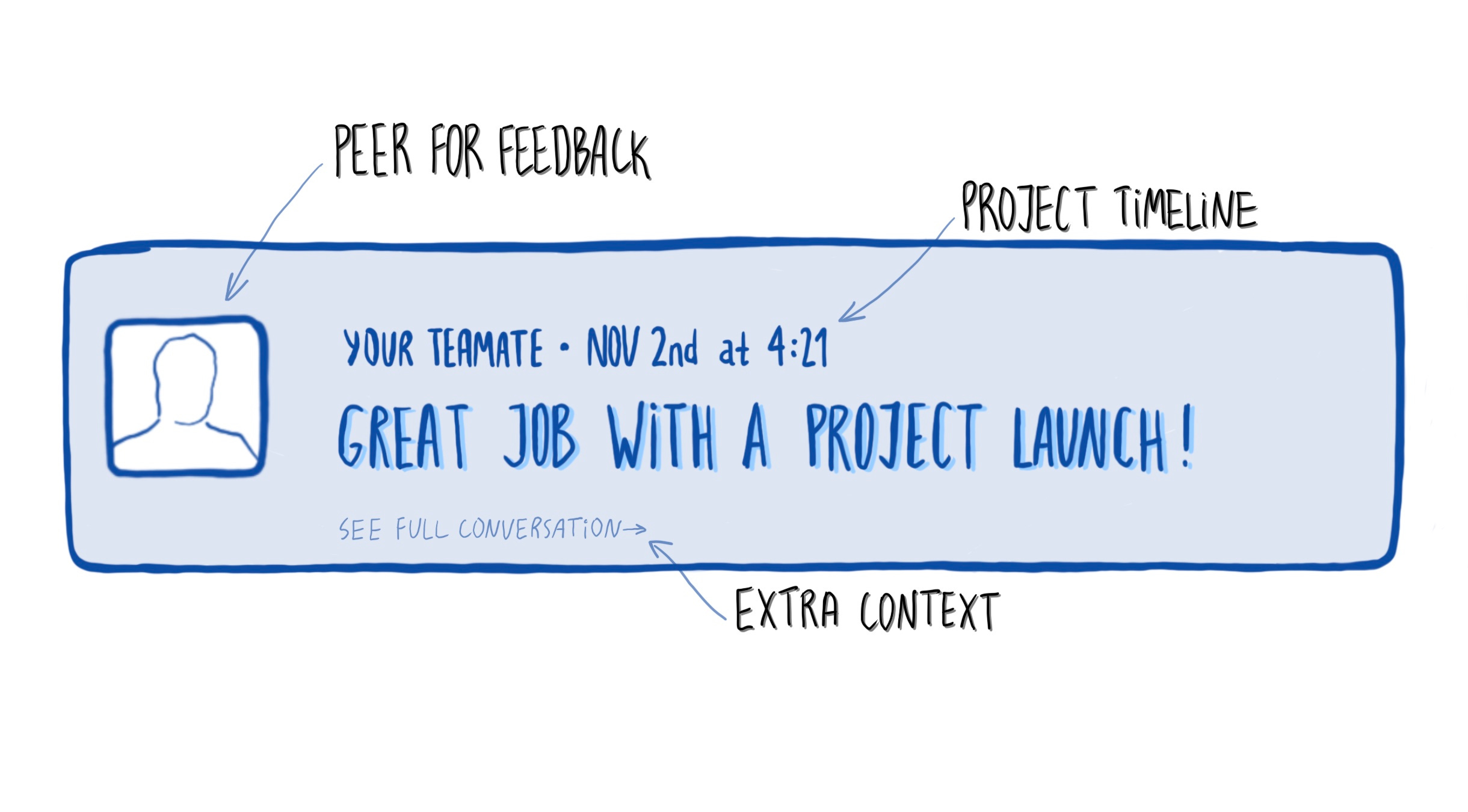
Twice a year, I sit down to write my performance review at work. It's often hard to remember what, when, and how, especially when companies grow quickly with little time to reflect on our contributions. A better way is to collect feedback and praise as they happen. For example, I bookmark Slack messages with praise: it shows who gave me feedback, when and extra context I can always go back to.
Regardless of how you save praise messages, you can use shorter messages during performance reviews and map them to company OKRs and accomplishments. Instead of Slack, you can forward yourself an email with praise, take screenshots or use a to-do app to track your achievements. For all the solopreneurs out there, customer feedback is probably your best praise.
Find medium to present accomplishments
Everyone's work results are different, so it's hard to develop a universal template for presentation. Even if you're not actively looking for a job, organizing your professional life makes you look more credible when you speak at conferences, for example. Some principles that are worth considering:
Publicly available work makes it easier for others to learn about your expertise;
Extra context is necessary to explain what you did to people outside your team;
If you're looking for a job, contact CTA is a must.
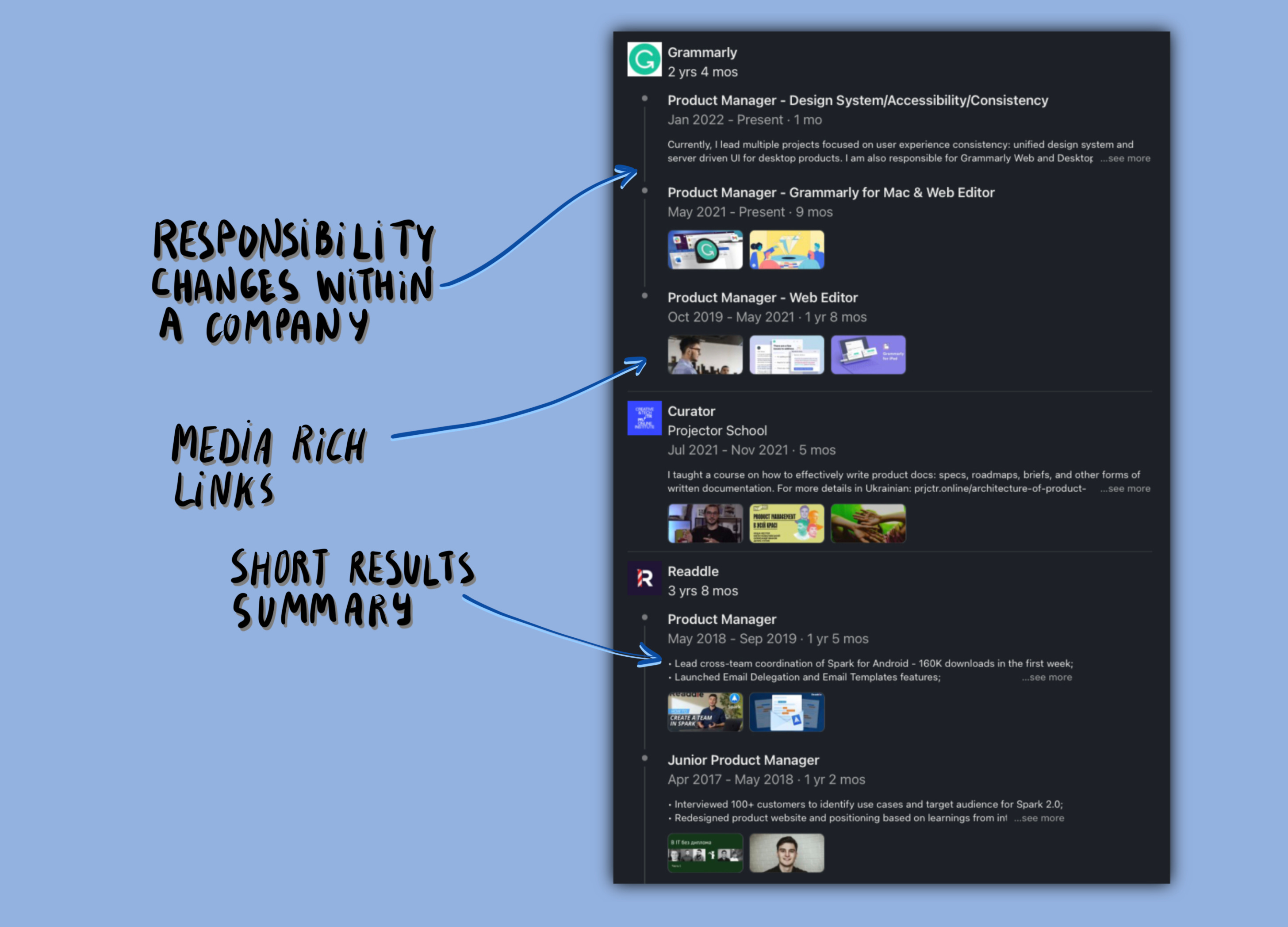
A commonplace for people to present their work is LinkedIn. For example, I post about our product launches at Grammarly and updates on the Digital Hygiene blog. CV ceased to exist for me the moment I started using LinkedIn. My Slack bookmarks are examples of my work results; my LinkedIn summarizes my career journey, and my online presence reflects my professional skills.
Seasoned creators end up with their custom website as it gives them total control over presentation. Still, they often lead visitors to a website from their social media. There are other places to share your work: Dribble for design, GitHub for code, Substack for writing, you name it. You need to find a platform where people will appreciate your work.
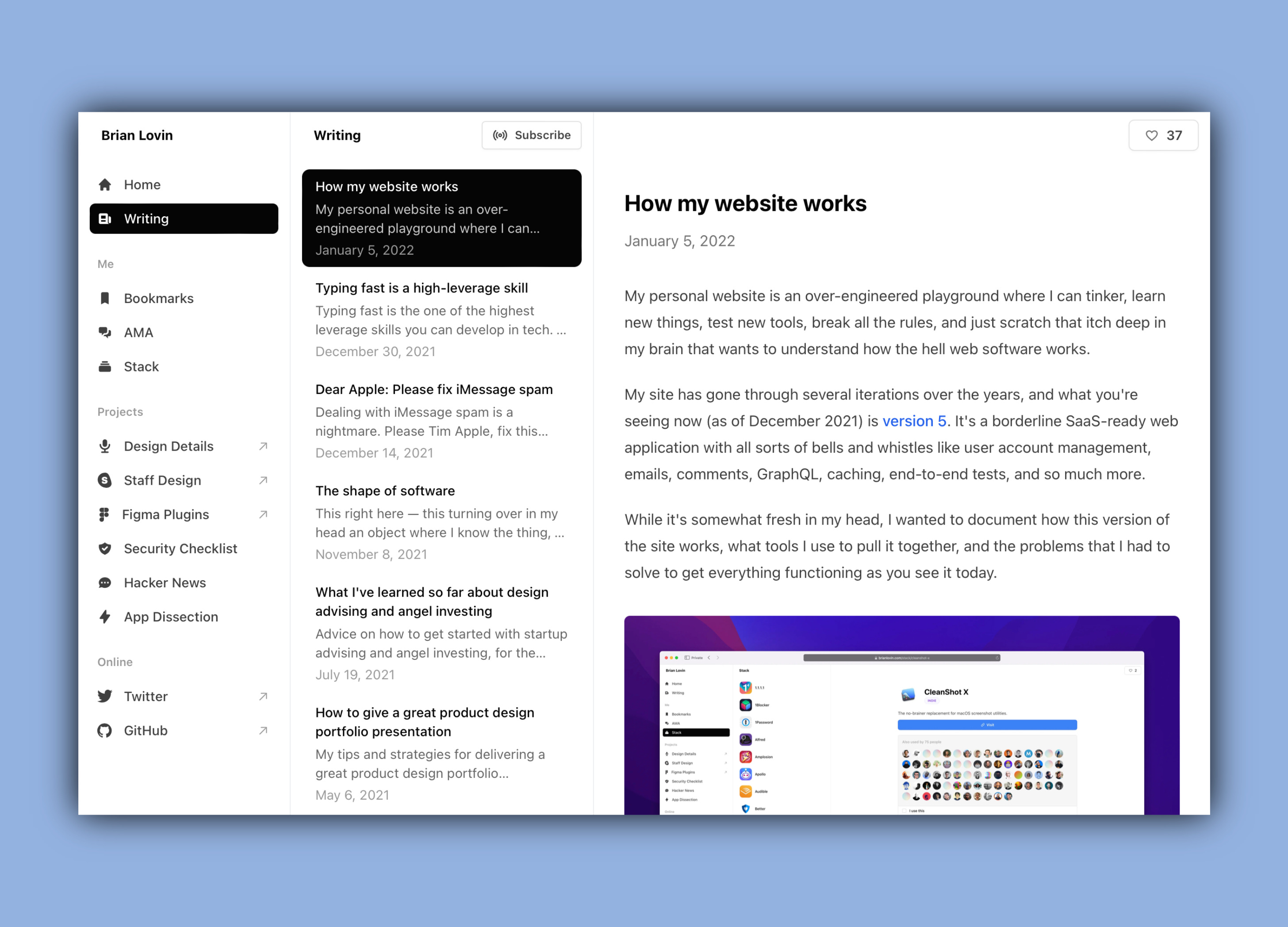
For example, Brian Lovin created an entire web application to capture his online presence, skills, and interests - mindblowing - brianlovin.com
Use online content as a fuel for career growth
#buildinginpublic is a trendy way to share online what you do and learn continuously. While popular among solopreneurs, it has benefits for others too, since whenever you publish online content, you get two benefits:
1. Structure your knowledge and share it with others
2. Create content that helps you meet like-minded professionals
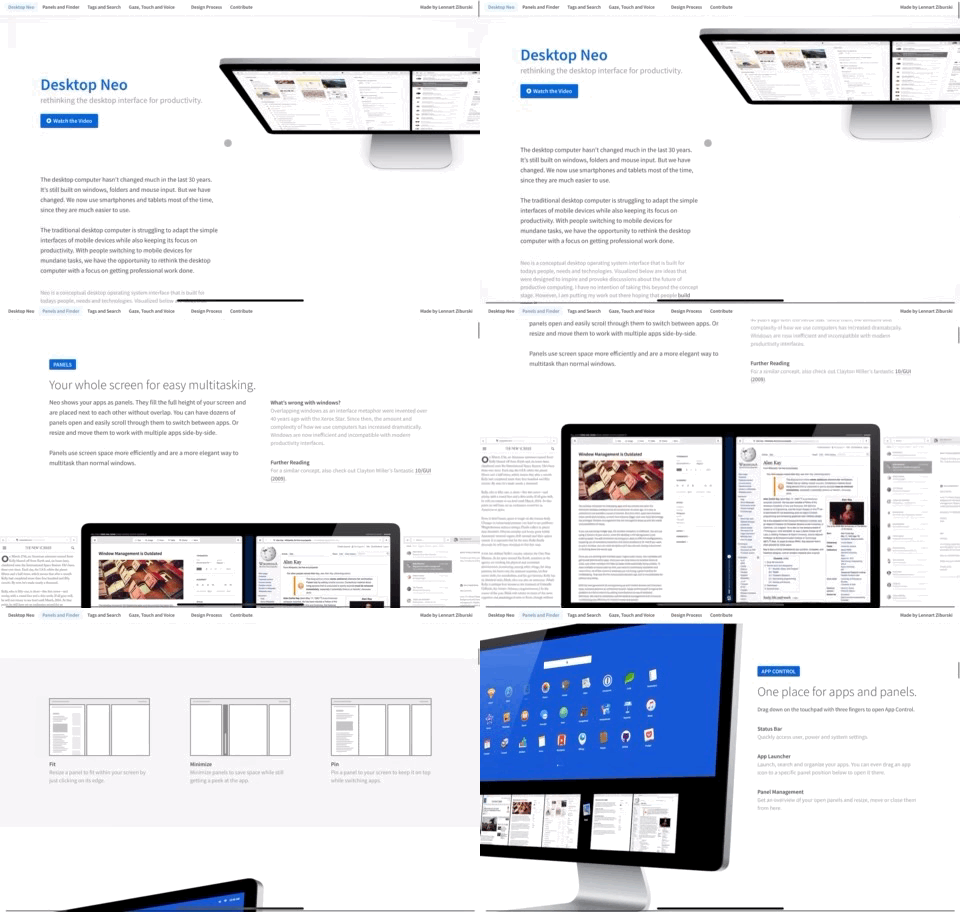
A word of caution - not all companies allow you to publish your work, or the marketing team may want to moderate what gets shared, so keep that in mind. LinkedIn or Twitter are both good to start sharing the results of your work. Taking it to the next level, see this incredibly detailed case study rethinking desktop interface.
The level of details and thought is rare for even paid projects, so anyone looking to work with Lennart will immediately know how deeply they thinks about work.
Capturing and presenting our work accomplishments can give a stronger sense of self-worth. A bonus is that you have valuable facts when you need to apply for an educational program, visa, or any other program that asks you to list your accomplishments. Having all content captured in one place lets you curate the story of your career and online presence overall.
Steps I took (so you can) to update my professional online presence:
1. Wrote a short bio that I use across all social media sites now;
2. Collected all articles I published on LinkedIn under relevant experience;
3. Updated my work experience to reflect my career progress;
4. Started planning how to turn kulyk.tech into a landing website for all my online presence inspired by what Brian built 🤩
Digital Hygiene Recommends
As much as I like LinkedIn (it helped me find my first job ever), it sometimes feels cringe. Trung Phan has a detailed article why monetization strategy and product features make the social network cringy.
Another interesting take on when people should start sharing their ideas online, e.g. Learn in Public from swyx.io.
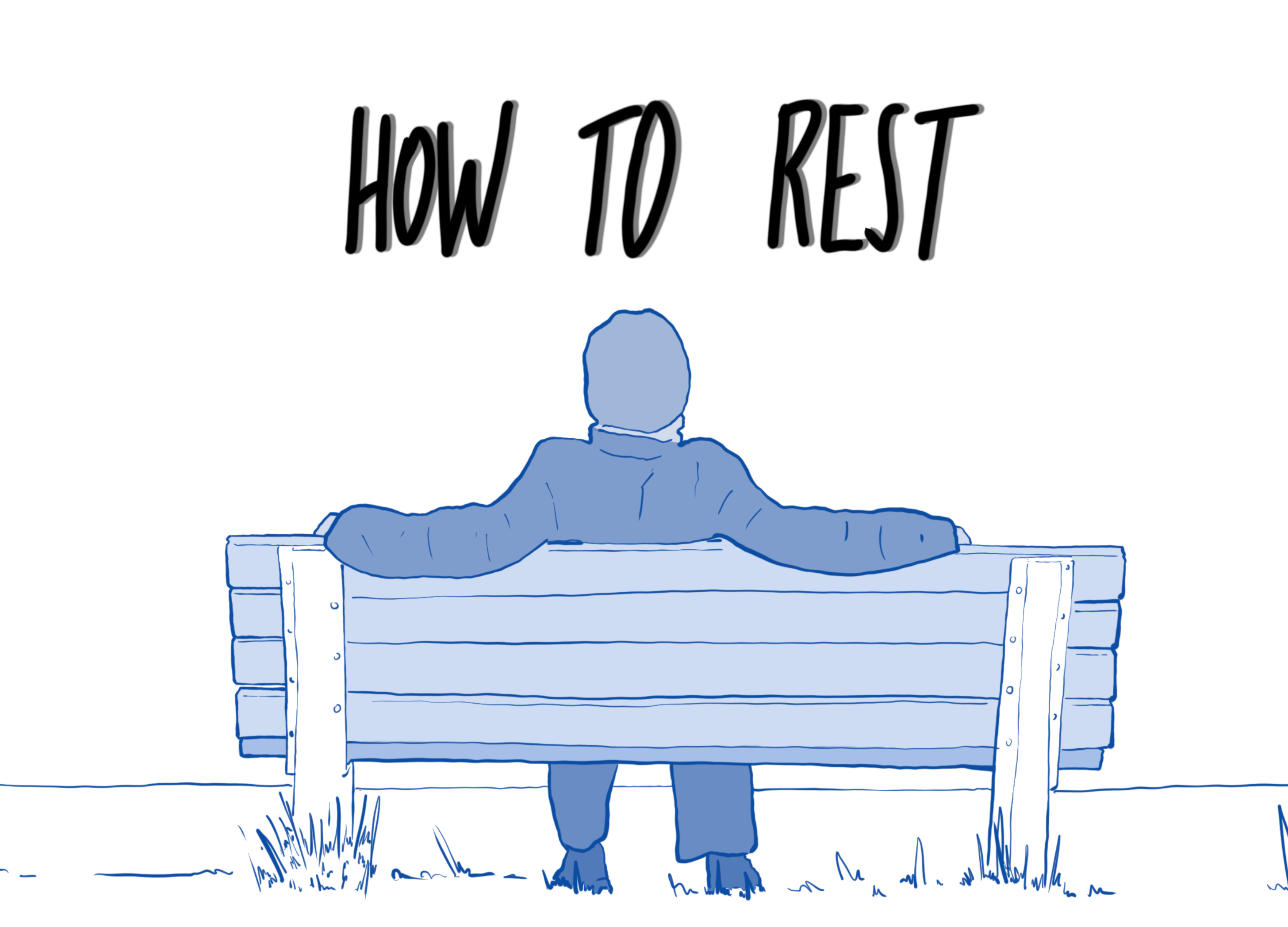
With the holiday season ending, I hope you're rested. Today, I'm sending a revised article on how to remain calm 🙂 Internet is full of "productivity hacks," yet little about rest. Besides sleep, exercise, or diet, we rarely talk about rest from technology.
This article is not work-life balance advice; instead, it focuses on different stages of tiredness and explores activities to restore energy. Pandemic removed boundaries between work and leisure at home for many. When we work overtime, we use future work resources to get the job done now. I don't believe it's a sustainable tactic to rush to meet deadlines, followed by a rest later. To keep my energy level stable, I established my "rest baseline":
I have a positive outlook, take responsibility for projects and tasks, and brainstorm new ideas. There is a sense of mental clarity. I can think long-term and plan.
Track tiredness levels
Let's imagine that each tiredness level ("T-level") can match a specific rest activity. T1 is when you're least tired, while T4 is when you're on the edge of burnout.
T-Level 1: As the workday ends, you feel fatigued. It's hard to come up with creative ideas, but you can carry on with administrative work;
T-Level 2: As the workweek ends, you feel overwhelmed. You avoid making important decisions or planning long-term. Even administrative work is daunting;
T-Level 3: Regardless of the day, you feel exhausted. You don't have the same excitement at work as you used to;
T-Level 4: You're irritated with the work and people on your team. Everything seems wrong. You become passive-aggressive.
Use effective rest strategies
Assuming you know your "tiredness level," here are ideas for rest strategies.
T-Level 1 → Evening Chill: A short-term rest can help you get distracted from work. The goal is to switch your main focus so that your brain doesn't keep actively working on a work assignment, for example:
Go for a walk. After switching from an active work mode, you need to slow down mentally. Listening to calm music helps;
Read something you like. It shouldn't be related to work, as you don't want to stimulate the brain further.
T-Level 2 → Low-Key Weekend: At this point, rest needs to last for a few days instead of hours. Again, it's important to get distracted from active work focus. If you work with technology, replace screen time with physical activity: my personal favorite is decluttering - it helps me review what's happening in my life and get rid of unnecessary distractions:
Do yoga, hike, or walk to get 10k+ steps;
Substitute screen time with board games or just social time with friends and talk about everything else but work.
T-Level 3 → Vacation Retreat: This level is alarming. You may feel that you only need a weekend rest, but you'll end up tired again once you start working. If it continues for too long, you end up burning out. It's worth taking a week off your day-to-day activities because you don't want to see triggers and reminders about daily worries.
If you don't usually read hardcopy books, now may be a good time;
If you live in a city, you may enjoy spending time in nature. Once you get bored there, you'll remember all the great things about your regular life and work.
T-Level 4 → Sabbatical: This level of tiredness would require the most time to recover. Since you're exhausted at this point, any activity may seem daunting in and of itself.
Taking time to connect with family and friends offline;
Take a "digital and work detox".
People often rely on taxing rest activities such as social media browsing or binge-watching when tired. While these seem like rest, we often end up feeling worse. My guess here is that most of those stimulate our brain with more information. I'd argue that those have to be avoided, but feel free to experiment with them on your own. I often got angry with notifications or apps on my phone, but they weren't the source of stress itself. So make sure you find what triggers you.
The elimination diet is a meal plan that removes specific foods from your diet to identify what harms your body. I tried the same with my social media presence.
1️⃣ What amount of online presence is enough?
2️⃣ To consume or to create?
3️⃣ What does my minimalist social media presence look like?
Media personalities who appear on our feed can lead us to believe that if someone doesn't broadcast their happiness online, they may be unhappy. That's far from the truth; people are happy and successful without social media presence. Cal Newport is one of many. He writes for the New Yorker, presents at conferences, runs a business without social media accounts.
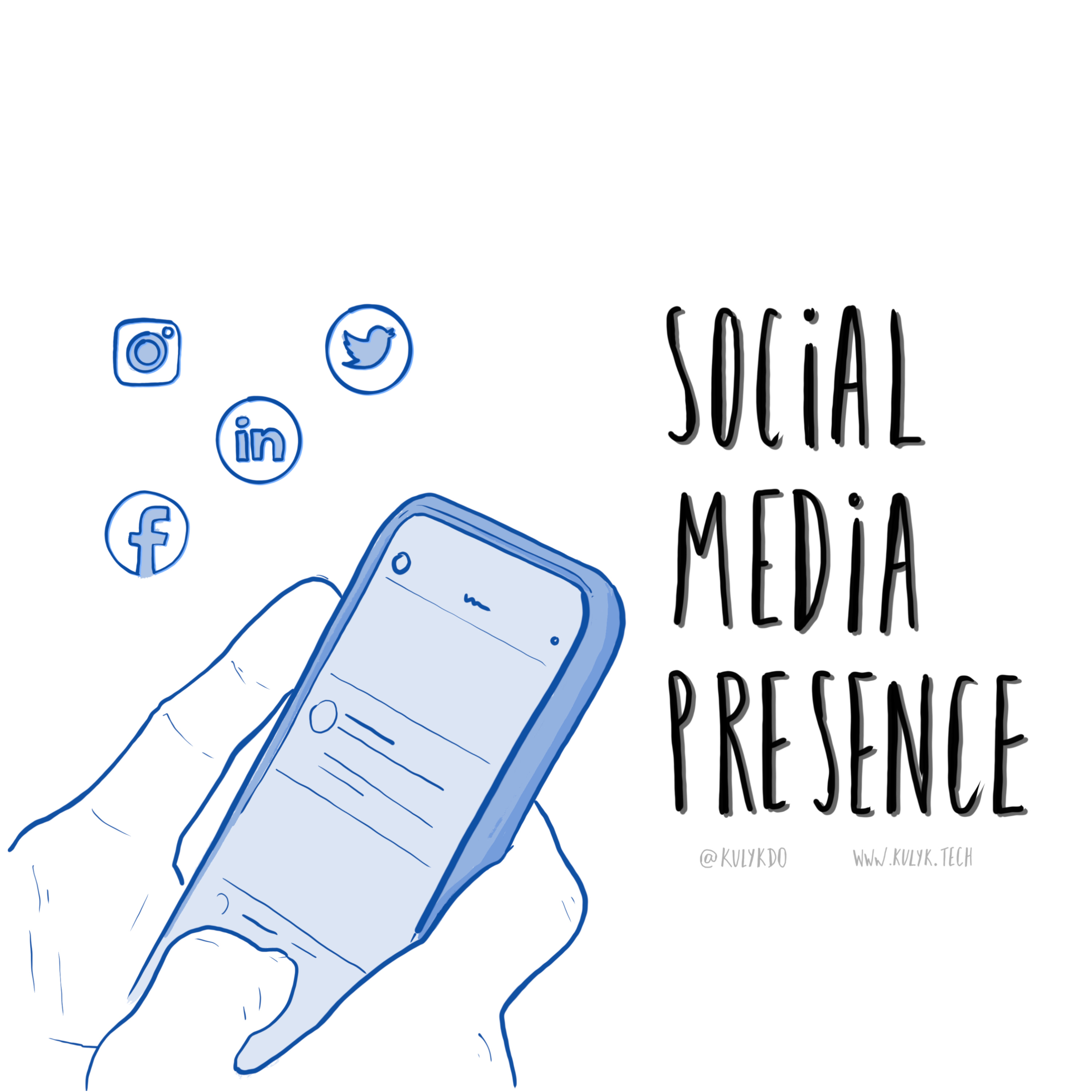
I've been reflecting on my social media habits lately: what I consume, share, how often. Initially, I went with a flow and did what others did - shared my personal life online. However, I never felt comfortable posting my family and vacation pictures. If anything, the immense power of broadcasting your voice online is better used for sharing ideas. I went completely offline from all platforms and then started to iteratively introduce one after another. As a result I deleted a couple of accounts and removed a bunch of personal data online. My presence became even more structured when I wrote down my rules, as you'll see below.
To consume or to create?
I was never obsessed with building an audience online for myself. For years, I was a fan of a calm, private lifestyle. Only recently, I got interested in creator economy - a juxtaposition to a typical aspirational lifestyle persona. A creator is supported directly by their fans based on the quality of work they produce.
The Minimalistic Entrepreneur book says there are three groups of people.
Ben McConnell and Jackie Huba call this the "1% Rule": On the internet, they say, 1 percent create, 9 percent contribute, and 90 percent consume.
I believe people do all three: create, contribute and consume. For example, I write online, thus create. I read what others write and respond with comments, thus contribute. I'm interested in learning, therefore consume. When you’ll discover your creation-contribution-consumption balance, you’ll have a fulfilling learning experience and build stronger connections with people.
What does my minimalist social media presence look like?
These are my principles for social media presence:
Create value for others, but make it valuable for myself first;
Enjoy the craft process instead of chasing growth;
Focus on topics I like instead of what's trending;
Connect with people, pay attention to what they say, ask questions.
If you like the principles and want to see how I practice them, subscribe to connect with me :)
My love for minimalism is reflected in my social media presence: Twitter, LinkedIn, and Substack (my inner minimalist hoped for one tool, but it's a bad idea to put all the eggs in one basket). This is how I use the tools:
🗣 Share my ideas and converse about them with others. Social media is a powerful distribution tool, but you don't have to use every platform to be heard. Twitter is my platform of choice. Think about it: the screen space for a tweet is the same as for responses. In contrast, Instagram is an "announcement platform" - posts take 80% of the screen, with reactions and comments taking about 20%. Twitter threads are not always healthy and constructive, yet I had a positive experience. Substack is good for long-form writing. The newsletter is my way to practice what I preach as I try to build it with a product mindset.
🤩 Get inspiration and find fresh ideas. I like to create and consume equally. Substack and Twitter are the only platforms where I can organize consumption how I want it. Direct connection via email newsletter ensures that I always get notified about the new release without an algorithm filtering it out. Twitter has a chronological timeline which helps me follow all updates from creators (I don't like to see the algorithm-based feed incentivized to engage me for longer).
🤝 Connect with people to build weak ties. I believe in the power of weak ties, so I try to help people when I can, even if we barely know each other. Many of these interactions are work-related, so LinkedIn is an effective tool to connect with people and follow their professional stories. More importantly, my Twitter following is a portfolio of weak ties I try to nurture.
An elimination diet has two phases "Removal" and "Reintroduction." Try to completely go offline to discover how social media affects your life. Then, intentionally add pieces of your online presence: connect with friends, find a job, and learn a new skill. People say technology owns them, but I disagree because we allow technology to own us. Once you set a purpose and support it with tools, your behavior will likely change. The principles can change, but the process of elimination can be re-used to define new principles.
Bonus Facebook evacuation guide
Check who appears on your feed, if you plan to stay in touch:
Professional network → connect on LinkedIn;
Creator you follow → subscribe to a newsletter for direct connection;
Friend or a relative → I bet you have a private chat with them.
Unfollow people as you add them to one of the buckets above. If you go offline, add a redirect notice for visitors and limit people who can message you. For a more detailed guide, check the Washington Posts article.
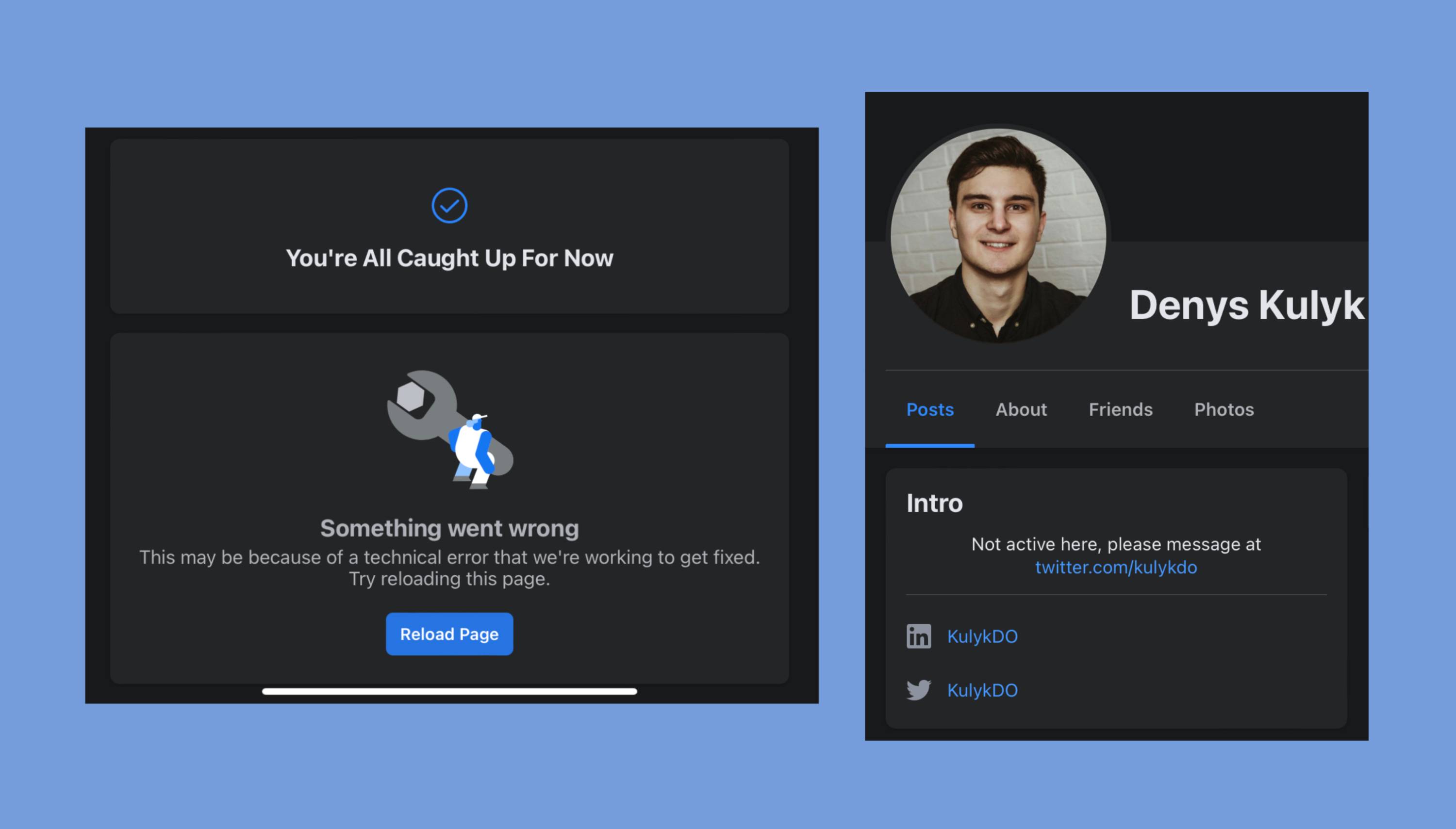
(left) once you start aggressively unfollowing people - facebook says “you’re caught up” and thinks something is broken. (right) redirect notice in bio.
Digital Hygiene recommends
Great article from Stratechery on the cultural value of Twitter, how it’s different from Facebook, and what frontiers can product explore - link.
Metaverse had a lot of media attention lately, but there is a chance your online presence may soon move to smaller and private networks. Discord is one of the places where these networks start to emerge - link.
What you consume will have an effect on what you think and how you behave. Polina from the Profile talks about her information diet and intentional removal of mindless and sensational content - link.
An example funnel of online networking is 1/ 10/ 100 /1000 → friends /acquaintances /person subset of a community /person community. I liked this opinionated take on making friends online - link.
For anyone experiencing a cold season, be like Chevy!
1. Why do people need to be 13+ y.o. to use social media?
2. Why do companies create products for kids?
3. So is technology good or bad for kids?
I'm trying to draw illustrations in the new style, please reply to this email and let me know what you think 🙂 Reference photo by C.Ryan.
Why do kids need to be 13+ y.o. to use social media?
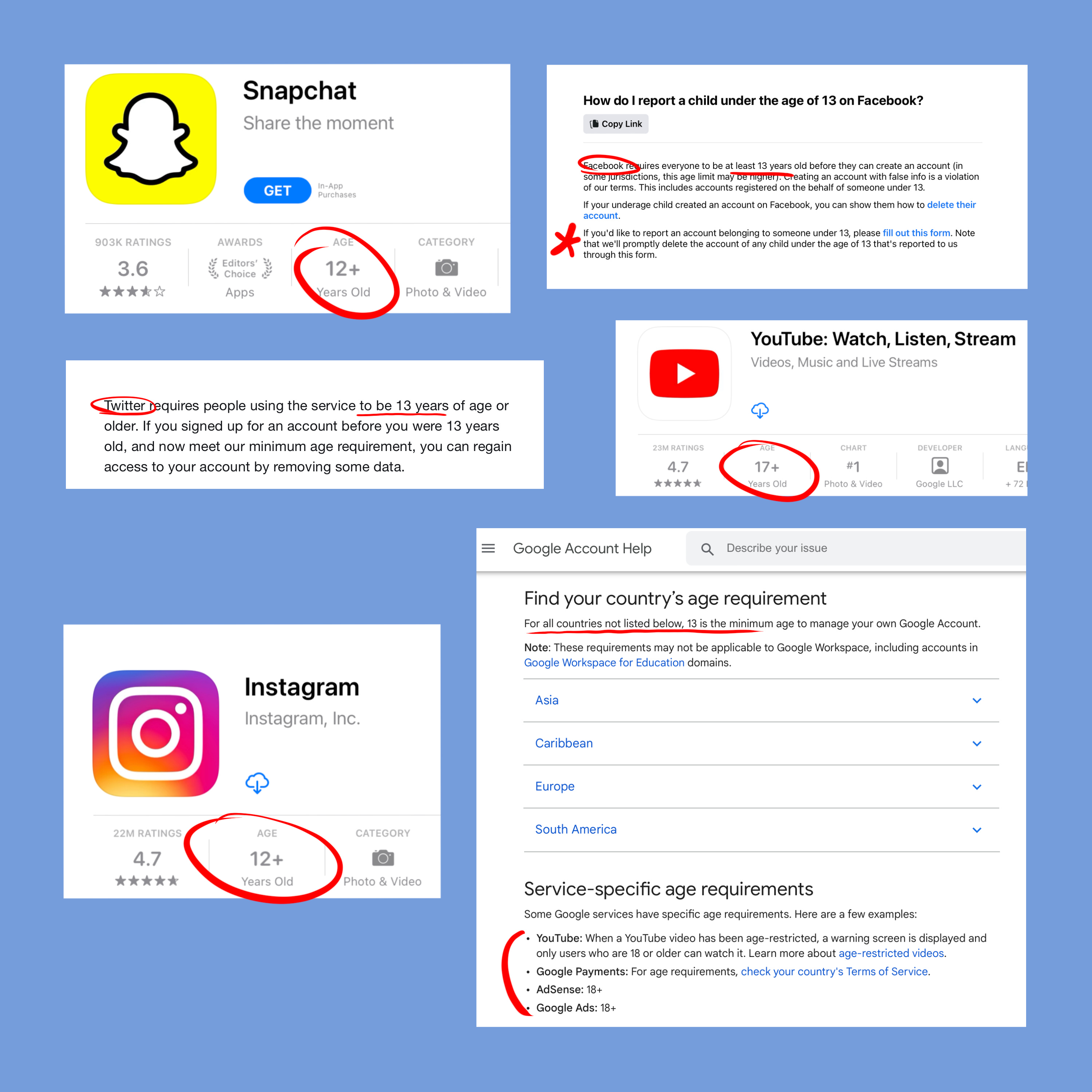
Many internet services we use daily become available at 13. The reason is COPPA law. At the dawn of e-commerce in 1998, US Congress introduced COPPA to regulate what personal information websites can collect about users under 13. COPPA is interesting for two reasons: 1) it's somewhat outdated to regulate the fast pace tech industry; 2) few people understand this age. From WSJ:
Parents might think of the age-13 requirement as a PG-13 movie rating: Kids might encounter a bit more violence and foul language but nothing that will scar them for life. But this isn't an age restriction based on content. Tech companies are just abiding by a 1998 law called the Children's Online Privacy Protection Act (COPPA)… But it has inadvertently caused 13 to become imprinted on many parents' psyches as an acceptable age of internet adulthood.
I bet you know kids younger than 13 who use social media. Companies may know about it too. For instance, TikTok knew it had underage users and was fined $5.7 million. My assumption - companies weigh risks against user growth. An extra step for age verification will catch underage users and filter out less engaged users. New user signup is a critical metric for a product, so that the fine may be worth it.
Age verification is interesting on its own. You'd think that social media algorithms that know the color of the fork you want to buy will identify underage users quickly. Nope. Algorithms perform well once a person does something on a platform (likes, personal info, etc.). Recently, Facebook started analyzing user activity to identify underage users.
Kids are the new audiences for companies that hit a user growth plateau. Products want to become a one-stop shop for all family communication or entertainment. Here is an excerpt fromYouTube for Kids announcement:
This is the first step toward reimagining YouTube for families, but with your help, the app will continue to get better over time...
Most tech companies started as adult-only services. Eventually, they look at the kids market to capture future users: capture attention early → get them used to a product → when they grow up, a product becomes a default choice. That's one of the reasons Instagram is concerned with TikTok, which captures the younger generation's attention.
This playbook is similar to how companies create products for students. Students are more likely to continue using a familiar product when they start working. The earlier people use a product, the better.
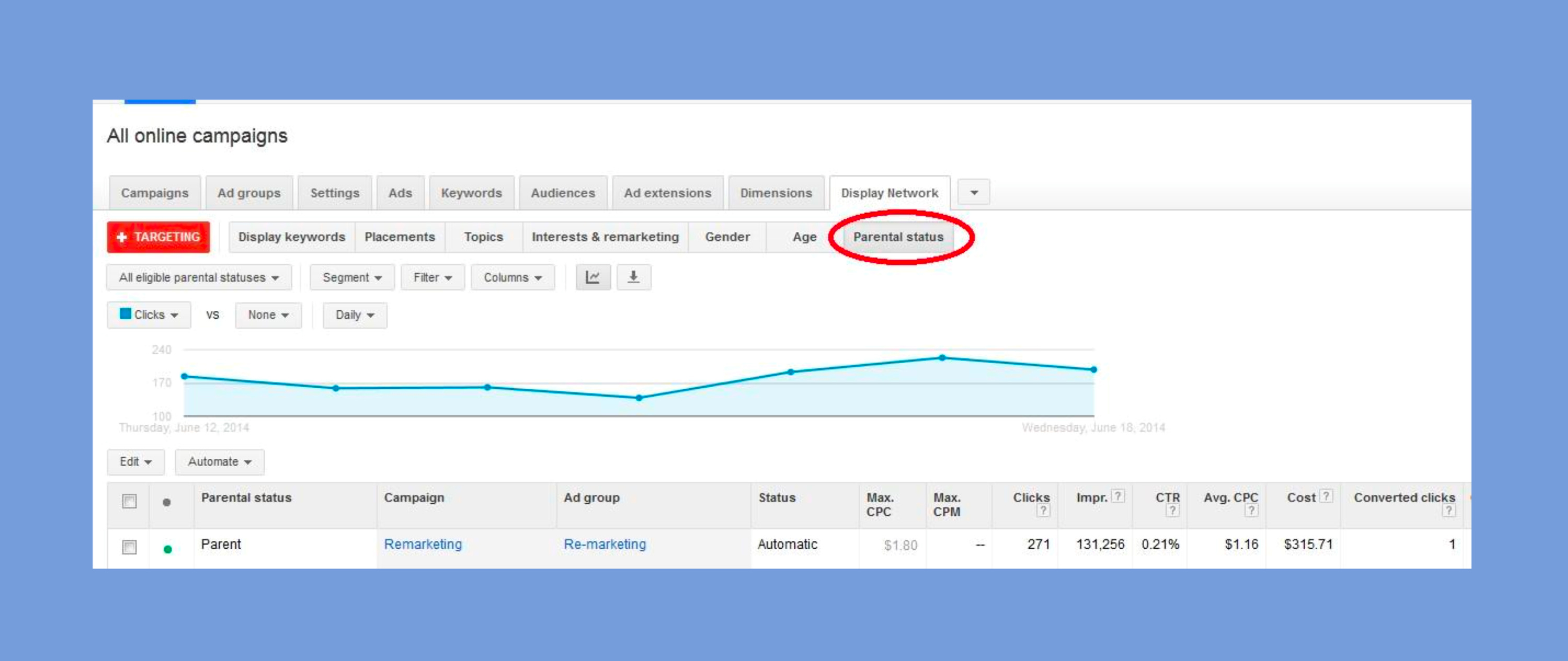
Let's also talk about product marketing. Companies rely on ads to promote products - but how do ads reach users that can't be targeted with ads directly? I asked my friend Denys Shamatazhy who is responsible for Ads at VK. While you can't select an age below 13 (or 18 in some countries), it's relatively easy to run parent-centric and kid-centric ads.
With parent-centric ads, you can use the 'parental status' feature. First tho, users need to provide their 'parental status.' For kid-centric ads, you can target based on interest. For example, use game advertisement for an audience enjoying gaming, tech gadgets, etc. You don't target underage users, but they see an ad if they use a platform and share this interest. That's most likely why and how YouTube Kids injects promos based on video categories but restricts further purchase flows.
So is technology is good or bad for kids?
It's ironic that adults can't figure out whether social media is good or bad. We know it connects people, but it polarizes us. We want to stay updated with news, but this creates a stream of misinformation. On top of this, we (adults) need to decide if social media is suitable for kids.
Prohibiting kids from using technology can backfire and prompt kids to use tech secretly. We need to ensure that companies who create products for kids use a business model that will incentivise them to keep kids and their data safe. We saw examples when companies with ad business and engagement-driven platforms aren't the best solution. US Senate is now introducing an updated act, which I find interesting cause it calls out specifics of how platforms work (likes, push notifications, etc.)
I have more questions than answers myself, but I find those questions intriguing since they help me see the full picture of the challenge. What's your take?
When companies identify a child account, some personalise their experience to keep them safe on the platform. For instance, keep content private by default and turn off auto-play by default. Here is more from YouTube and parents guide from TikTok.
Protocol has an article (feels a little like Apple promo) on how hardware companies may be better equipped to collect and verify user age. They can then prevent access to certain websites on a device level. For example, don't even show apps on the store that don't fit the age.
Last but not least, I want to congratulate Kabosu and express my appreciation for being a go-to meme reply for almost all my chats. Happy birthday, Kabosu 🥳